
Applications are the backbone of productivity in Windows 11. Whether drafting documents in Microsoft Office, browsing the web with Google Chrome, or joining virtual meetings via Zoom, users depend on these apps daily. Smooth performance is critical, and when errors occur, they can disrupt workflows instantly.
Unlike minor inconveniences such as cosmetic glitches, application errors directly affect essential tasks: a student unable to submit assignments because Word crashes, a professional missing deadlines due to Chrome freezing, or a team losing communication when Zoom fails mid‑meeting. These scenarios highlight why understanding and resolving app errors is vital.
Why App Stability Matters in Windows 11
Windows 11 emphasizes seamless integration between system resources and applications. Features such as improved memory management, enhanced GPU scheduling, and tighter security controls are designed to support modern apps. However, these same features can introduce compatibility challenges.
Applications rely on drivers, libraries, and system services. When any of these components malfunction, errors surface. For example:
- Office apps may fail to launch due to corrupted add‑ins.
- Chrome may crash because of outdated graphics drivers.
- Zoom may disconnect when firewall rules block its ports.
Stable apps ensure productivity, communication, and collaboration remain uninterrupted.
The Growing Complexity of Application Ecosystems
Modern apps are no longer standalone programs. They integrate with cloud services, plugins, and third‑party extensions. For instance:
- Microsoft Office connects to OneDrive, Teams, and SharePoint.
- Google Chrome relies on extensions, sync services, and GPU acceleration.
- Zoom integrates with calendars, cloud recording, and collaboration tools.
This complexity increases the likelihood of errors. A single misconfigured extension or outdated plugin can destabilize the entire application.
Common Symptoms of App Errors
Users typically encounter one or more of the following issues:
- Office: Crashes when opening files, slow performance, or “Not responding” messages.
- Chrome: Freezing tabs, excessive memory usage, or “Aw, Snap!” error pages.
- Zoom: Audio/video not working, frequent disconnections, or login failures.
These symptoms are disruptive and can halt productivity entirely.
The Importance of Systematic Troubleshooting
App errors can feel overwhelming, especially when they occur during urgent tasks. However, most issues can be resolved through systematic troubleshooting. Windows 11 provides built‑in tools such as Task Manager, Event Viewer, and compatibility settings, while app developers release patches to address known bugs.
By approaching app errors methodically—starting with basic checks and progressing to advanced solutions—users can restore functionality without resorting to drastic measures like reinstalling the operating system. This structured approach saves time and reduces frustration.
Why This Guide Matters
This article series is designed to serve as a comprehensive resource for Windows 11 users facing application challenges. It will:
- Explain the root causes of common app errors.
- Provide step‑by‑step instructions for resolving them.
- Offer advanced techniques for persistent problems.
- Share preventive strategies to minimize future disruptions.
By following this guide, users will gain both practical solutions and a deeper understanding of how applications interact with Windows 11. This knowledge empowers them to troubleshoot confidently, ensuring that Office, Chrome, and Zoom remain reliable across all environments.
Common Issues
Application errors in Windows 11 can appear in many forms, ranging from minor glitches to complete crashes. Because apps like Microsoft Office, Google Chrome, and Zoom are essential for productivity, even small disruptions can have significant consequences. Below are the most common issues users face, along with explanations of why they occur.
Microsoft Office Errors
1. Application Crashes on Launch
- Causes: Corrupted installation files, outdated add‑ins, or conflicts with Windows updates.
- Impact: Users cannot access Word, Excel, or PowerPoint, halting document creation and editing.
2. “Not Responding” Messages
- Causes: Large files overwhelming system resources, outdated drivers, or background processes interfering.
- Impact: Productivity slows as users wait for the app to recover or restart.
3. File Compatibility Issues
- Causes: Opening files created in older Office versions or with unsupported formats.
- Impact: Formatting errors, missing features, or inability to open files.
4. Add‑in Conflicts
- Causes: Third‑party add‑ins not updated for Windows 11.
- Impact: Office apps crash or behave unpredictably.
Google Chrome Errors
1. “Aw, Snap!” Error Pages
- Causes: Corrupted cache, outdated extensions, or insufficient memory.
- Impact: Tabs crash, preventing access to websites.
2. Excessive Memory Usage
- Causes: Multiple tabs and extensions consuming resources.
- Impact: System slows down, affecting overall performance.
3. Freezing or Unresponsive Tabs
- Causes: Conflicts between extensions, outdated graphics drivers, or malware.
- Impact: Browsing becomes unstable, forcing users to restart Chrome.
4. Sync Failures
- Causes: Incorrect Google account settings or network instability.
- Impact: Bookmarks, history, and passwords fail to sync across devices.
Zoom Errors
1. Audio/Video Not Working
- Causes: Outdated drivers, incorrect device settings, or blocked permissions.
- Impact: Users cannot participate effectively in meetings.
2. Frequent Disconnections
- Causes: Network instability, firewall restrictions, or outdated Zoom client.
- Impact: Meetings are interrupted, reducing communication efficiency.
3. Login Failures
- Causes: Incorrect credentials, server outages, or two‑factor authentication issues.
- Impact: Users cannot join meetings or access Zoom features.
4. Screen Sharing Problems
- Causes: Graphics driver conflicts, disabled permissions, or outdated Zoom versions.
- Impact: Presentations and collaborations are disrupted.
Cross‑Application Issues
1. Compatibility Problems After Updates
- Causes: Windows updates replacing stable components with newer versions.
- Impact: Apps that worked flawlessly before updates suddenly fail.
2. Security and Permissions Errors
- Causes: Enhanced Windows 11 security blocking apps from accessing hardware or files.
- Impact: Apps cannot use microphones, cameras, or storage.
3. Cloud Integration Failures
- Causes: Network instability or outdated authentication protocols.
- Impact: Office fails to connect to OneDrive, Chrome fails to sync, Zoom fails to record to the cloud.
Why Identifying Common Issues Matters
Recognizing these patterns allows users to troubleshoot logically. Instead of guessing, they can match symptoms to likely causes and apply targeted fixes. This structured approach reduces downtime and ensures that solutions are effective rather than temporary.
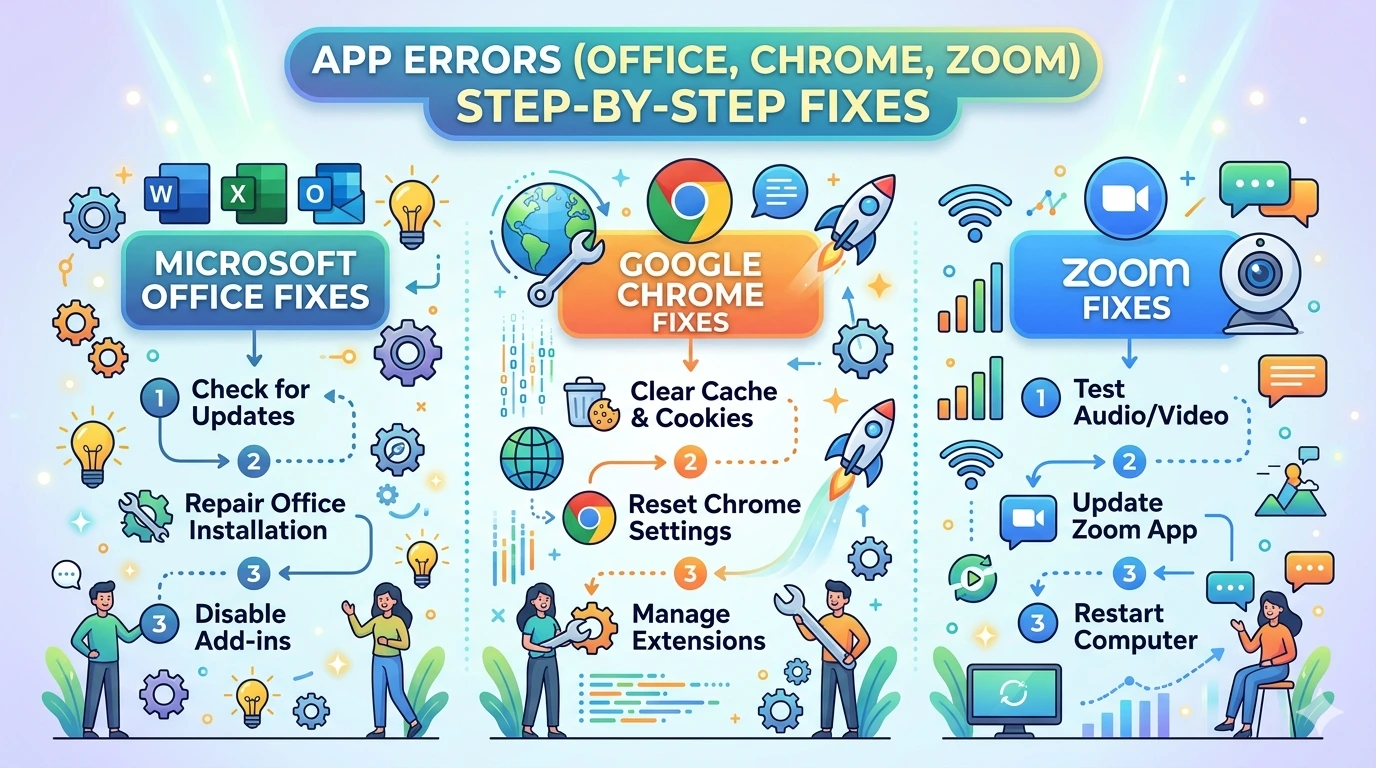
App Errors (Office, Chrome, Zoom) Step‑by‑Step Fixes
Application errors can be disruptive, but most can be resolved through systematic troubleshooting. By following a logical sequence of steps, users can restore functionality in Microsoft Office, Google Chrome, and Zoom without unnecessary reinstalls or data loss.
Microsoft Office – Step‑by‑Step Fixes
Step 1: Restart Office and Windows
- Close the app completely using Task Manager (Ctrl + Shift + Esc).
- Restart Windows to clear temporary conflicts.
Step 2: Disable Add‑ins
- Open Word/Excel → File → Options → Add‑ins.
- Select COM Add‑ins → Go.
- Uncheck all add‑ins, restart Office.
Step 3: Repair Office Installation
- Go to Settings → Apps → Installed apps.
- Select Microsoft Office → Modify → Quick Repair.
- If issues persist, run Online Repair.
Step 4: Update Office
- Open any Office app → File → Account → Update Options → Update Now.
- Updates often fix compatibility issues with Windows 11.
Step 5: Reset Office Settings
- Delete the Normal.dotm template (for Word) or reset Excel options.
- This clears corrupted configuration files.
Google Chrome – Step‑by‑Step Fixes
Step 1: Clear Cache and Cookies
- Open Chrome → Settings → Privacy and security → Clear browsing data.
- Select Cached images and files + Cookies.
Step 2: Disable Extensions
- Navigate to chrome://extensions/.
- Toggle off all extensions, restart Chrome.
- Re‑enable one by one to identify conflicts.
Step 3: Reset Chrome Settings
- Open Settings → Reset settings → Restore settings to their original defaults.
- This clears corrupted preferences.
Step 4: Update Chrome
- Open Settings → About Chrome.
- Chrome will check and install updates automatically.
Step 5: Check Graphics Drivers
- Outdated GPU drivers often cause tab crashes.
- Update drivers via Device Manager → Display adapters.
Zoom – Step‑by‑Step Fixes
Step 1: Restart Zoom and Windows
- Close Zoom completely via Task Manager.
- Restart Windows to refresh services.
Step 2: Check Audio/Video Settings
- Open Zoom → Settings → Audio/Video.
- Ensure correct microphone and camera are selected.
Step 3: Update Zoom Client
- Open Zoom → Check for Updates.
- Install the latest version to fix bugs.
Step 4: Adjust Firewall and Antivirus
- Ensure Zoom is allowed through Windows Firewall.
- Add Zoom to antivirus exceptions if blocked.
Step 5: Reinstall Zoom
- If issues persist, uninstall Zoom via Settings → Apps.
- Download the latest installer from Zoom’s official site.
Cross‑Application Fixes
Step 1: Run Windows Troubleshooter
- Settings → System → Troubleshoot → Other troubleshooters.
- Select the relevant app category (Internet, Audio, etc.).
Step 2: Check Event Viewer Logs
- Press Win + X → Event Viewer.
- Review Application logs for error codes.
Step 3: Perform Clean Boot
- Press Win + R → msconfig.
- Disable non‑Microsoft services.
- Restart to test apps without third‑party conflicts.
Step 4: Use System Restore
- Search System Restore in Start menu.
- Select a restore point prior to the issue.
Practical Example
Consider a professional whose Zoom disconnects during meetings, Chrome freezes on multiple tabs, and Word crashes when opening files. By following these steps:
- They repair Office installation to fix Word crashes.
- Clear Chrome cache and disable extensions to stabilize browsing.
- Update Zoom client and adjust firewall rules to restore meeting stability.
- Productivity is restored without reinstalling Windows.
Why Step‑by‑Step Fixes Work
This structured approach ensures that simple solutions are tried first, reducing risk and saving time. It also prevents unnecessary reinstalls, as most app problems stem from corrupted settings or outdated components rather than fundamental system faults.
Advanced Solutions
Basic troubleshooting often resolves application errors, but some cases require advanced interventions. These solutions target deeper system layers such as registry, compatibility settings, and diagnostic tools. They are especially useful for users who continue to experience instability after exhausting standard fixes.
Microsoft Office – Advanced Solutions
1. Registry Cleanup
Corrupted registry entries can destabilize Office apps.
- Press Win + R → type regedit.
- Navigate to HKEY_CURRENT_USER → Software → Microsoft → Office.
- Delete corrupted subkeys cautiously.
- Reinstall Office afterward.
⚠️ Always back up the registry before making changes.
2. Compatibility Mode Installation
If Office crashes after updates, run in compatibility mode.
- Right‑click Office shortcut → Properties → Compatibility tab.
- Select Run this program in compatibility mode for Windows 10.
3. Disable Hardware Graphics Acceleration
- Open Word/Excel → File → Options → Advanced.
- Check Disable hardware graphics acceleration.
- Restart Office.
This resolves crashes linked to GPU drivers.
Google Chrome – Advanced Solutions
1. Reset User Profile
Corrupted profiles cause persistent errors.
- Navigate to C:\Users<username>\AppData\Local\Google\Chrome\User Data.
- Rename Default folder to Default.old.
- Restart Chrome to generate a fresh profile.
2. Command Line Flags
Launch Chrome with flags to bypass conflicts.
- Create shortcut → Properties → Target.
- Add:
--disable-gpu --no-sandbox - This disables GPU acceleration and sandboxing temporarily.
3. Registry Fixes
- Press Win + R → regedit.
- Navigate to HKEY_LOCAL_MACHINE → Software → Policies → Google → Chrome.
- Remove corrupted entries.
4. Reinstall Chrome Cleanly
- Uninstall Chrome.
- Delete residual folders in AppData.
- Reinstall latest version from Google.
Zoom – Advanced Solutions
1. Advanced Audio/Video Diagnostics
- Press Win + R → type dxdiag.
- Review audio/video drivers for errors.
- Update drivers accordingly.
2. Compatibility Mode
- Right‑click Zoom shortcut → Properties → Compatibility tab.
- Run in compatibility mode for Windows 10.
3. Registry Cleanup
- Press Win + R → regedit.
- Navigate to HKEY_CURRENT_USER → Software → Zoom.
- Delete corrupted entries.
- Reinstall Zoom.
4. Network Configuration Adjustments
- Assign static IP for stable connectivity.
- Adjust firewall rules to allow Zoom ports (TCP 443, UDP 3478–3481).
Cross‑Application Advanced Solutions
1. Clean Boot Troubleshooting
Third‑party software can conflict with apps.
- Press Win + R → msconfig.
- Under Services, check Hide all Microsoft services → Disable all.
- Restart the PC.
If apps work in clean boot, re‑enable services one by one to identify the culprit.
2. Event Viewer Analysis
- Press Win + X → Event Viewer.
- Review Application logs for error codes.
- Use logs to identify root causes.
3. Group Policy Adjustments (Enterprise)
In corporate settings, group policies may block apps.
- Press Win + R → gpedit.msc.
- Navigate to Computer Configuration → Administrative Templates → System.
- Adjust policies restricting app execution.
4. Reinstall Windows Components
For severe corruption, reinstall app frameworks.
- Open PowerShell as Administrator.
- Run:
Get-WindowsCapability -Online | Where-Object Name -like 'App*' | Add-WindowsCapability -Online - Restart the PC.
Why Advanced Solutions Matter
These methods target the root causes of persistent application failures. While basic fixes address surface‑level problems, advanced solutions tackle deeper conflicts in registry entries, compatibility layers, and system services. For professionals, students, and businesses, mastering these techniques ensures reliability and maximizes productivity.
Preventive Tips
Fixing application errors is essential, but preventing them is even more important. By adopting proactive habits, users can minimize the risk of crashes and ensure smooth performance in Windows 11.
1. Keep Apps Updated
Regularly install updates for Office, Chrome, and Zoom. Developers release patches to fix bugs, improve compatibility, and enhance security.
2. Use Windows Update Carefully
Windows updates may affect app stability. Review optional updates before installation. If your apps are stable, consider delaying updates until compatibility is confirmed.
3. Avoid Excessive Add‑ins and Extensions
Third‑party add‑ins (Office) and extensions (Chrome) can destabilize apps. Install only trusted ones and keep them updated.
4. Create System Restore Points
Before major updates, create a restore point. This allows quick rollback if new updates cause instability.
5. Monitor Resource Usage
Apps like Chrome consume significant memory. Use Task Manager to monitor usage and close unnecessary background processes.
6. Secure Your Environment
Ensure firewall and antivirus settings allow Office, Chrome, and Zoom to function. Misconfigured security tools often block essential features.
7. Manage Multiple Accounts Properly
If you use multiple accounts (Google, Microsoft, Zoom), configure them carefully. Sync conflicts can cause errors.
8. Regular Maintenance
Run periodic scans with Windows Troubleshooter and app‑specific utilities. Preventive maintenance reduces the likelihood of sudden failures.
FAQ
Why does Word keep crashing when I open files?
Answer: Crashes often occur due to corrupted add‑ins or templates. Disable add‑ins and delete the Normal.dotm template to restore stability.
How do I fix Chrome’s “Aw, Snap!” error?
Answer: Clear cache and cookies, disable extensions, and update Chrome. If issues persist, reset Chrome settings to defaults.
Can outdated drivers cause Zoom audio/video problems?
Answer: Yes. Outdated audio or graphics drivers often cause stuttering or device detection failures. Update drivers via Device Manager.
Is it safe to use Office add‑ins and Chrome extensions?
Answer: Yes, if they come from trusted sources. However, outdated or poorly coded add‑ins/extensions can destabilize apps.
Why does Zoom disconnect frequently?
Answer: Frequent disconnections usually stem from unstable networks or firewall restrictions. Ensure Zoom ports are allowed and test with a stable connection.
What does “Not Responding” mean in Office apps?
Answer: This message indicates the app is overloaded or waiting for a process to complete. Large files, add‑ins, or insufficient memory are common causes.
Should I clear Chrome cache regularly?
Answer: Yes. Clearing cache prevents corrupted files from causing crashes and improves performance.
How can I prevent problems after Windows updates?
Answer: Delay optional updates until confirmed stable, create restore points, and keep apps updated independently of Windows.
Conclusion
App errors in Windows 11 can disrupt productivity, but they are manageable with the right approach. By combining systematic troubleshooting with preventive strategies, users can maintain reliable performance in Office, Chrome, and Zoom. Regular updates, careful configuration, and proactive monitoring form the foundation of stable application usage.